
Founded in 1932, Alaska Airlines has grown from a regional Pacific Northwest carrier into one of the most respected major airlines in the United States. As a prominent member of the one world alliance, Alaska Airlines blends high operational standards with a genuine culture of care.
Operating in strict compliance with the United States Air Carrier Access Act (ACAA), Alaska Airlines Wheelchair Assistance provides a comprehensive, barrier-free travel framework. With tailored terminal escorts, a unique ‘Fly for All’ digital app, and specialized equipment handlers, the carrier ensures all guests navigate the flying experience safely and with complete peace of mind.
Note—No need for a medical note to request these mobility services. You can access it for free during discomfort.
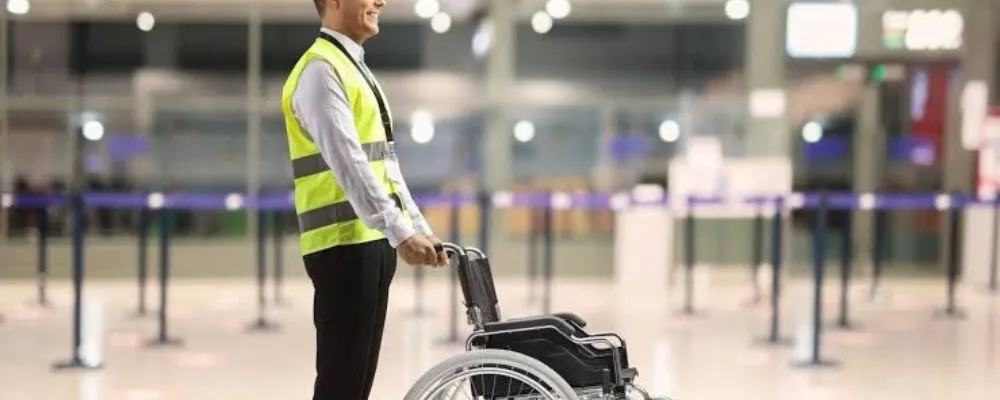
Does Alaska Airlines have wheelchair assistance?
Yes, Alaska Airlines provides comprehensive, complimentary wheelchair and guided airport assistance for all passengers who request it.
Available Mobility Services
Operating in full compliance with the United States Air Carrier Access Act (ACAA), these services ensure a safe, smooth, and dignified travel experience.
- Mobility Assistance: Trained airport handlers assist guests with manual terminal wheelchairs or electric carts, guiding them from the check-in lobby through TSA security checkpoints directly to the departure gate.
- Sensory & Hearing Accommodations: In-flight crews provide individualized safety briefings and detailed gate-change notifications for travelers who are blind, low-vision, deaf, or hard of hearing.
- ‘Fly for All’ App: Alaska offers a first-of-its-kind mobile app called Fly for All, specifically designed to help guests with cognitive or developmental disabilities, first-time flyers, and unaccompanied minors familiarize themselves with the steps of air travel before arriving at the terminal.
- Onboard Assistance: Flight attendants assist with opening food packaging, identifying meal items, stowing/retrieving carry-on baggage, and navigating the cabin aisle using specialized equipment.
- Medical Device Accommodations: Essential medical items, including CPAP machines, crutches, canes, and approved Portable Oxygen Concentrators (POCs), are carried free of charge and do not count against standard carry-on limits.
Core Stages of Alaska Airport Assistance
Alaska Airlines Airport Assistance is structured into four distinct chronological stages, ensuring full coordination from the moment you reach the departure terminal until you exit your destination gateway.
Departure Terminal Arrival
Arrive at least two hours before departure. Since curbside service is unavailable at most locations, have a companion notify an agent inside the lobby to request a terminal wheelchair. An escort will assist with your baggage check and guide you through the TSA checkpoint directly to your gate.
Boarding and Aircraft Entry
Take advantage of priority pre-boarding ahead of general passenger groups. Handlers will guide you down the jet bridge (or deploy mechanical lifts/ramps on the tarmac) and use a narrow onboard chair to assist non-ambulatory guests safely into their cabin seat.
Connections and Transits
During layovers, one attendant will meet you at the aircraft door with a terminal wheelchair. They will safely guide you across terminal levels using elevators or airport carts directly to your connecting gate. You can also request this mid-flight by alerting your cabin crew.
Destination Arrival and Exit
After general deplaning is complete, you will be assisted off the aircraft. Depending on your preference, your personal wheelchair will be delivered to the jet bridge door or sent to baggage claim. A handler will guide you through the terminal, help retrieve your luggage, and guide you directly to ground transit or pick-up zones.
How Do I Request Wheelchair Assistance on Alaska Airlines?
To guarantee the best possible travel experience, make wheelchair assistance reservations as early as possible and communicate your specific special requirements at check-in, in the boarding area, and onboard the aircraft.
Requesting Online or via the App
- During Initial Booking: When purchasing your tickets on AlaskaAir.com, look for the accessible services section on the traveler details page to check the box for wheelchair or guided assistance.
- Via the ‘Trips’ Portal: For existing reservations, log into your profile on the official website or mobile app, open the dedicated Trips page, select your scheduled flight, and add your mobility assistance request directly to your booking.
Requesting Through Phone
If you prefer to arrange your travel plans directly with a live agent, or if your journey involves a partner airline, you can call the following dedicated lines:
- Alaska Airlines Accessible Services Line: Call 1-800-503-0101 to speak directly with an agent trained in coordinating disability accommodations and specialized equipment rules.
- Partner Airline Bookings (Hawaiian Airlines): For reservations involving partner flights operated by Hawaiian Airlines, contact their team directly at 1-800-367-5320.
- Hearing-Impaired Assistance: Telecommunication Relay Services (TRS) are fully guided. Passengers can dial 711 on their text telephone to be seamlessly connected to the booking team.
Alaska Airlines Self-Service Wheelchair Program
For guests who prefer the flexibility of being assisted by someone they know rather than an airport employee, Alaska Airlines offers a Self-Service Wheelchair Program. Under this program, your own companion—whether they are flying with you or just dropping you off—can borrow an airport wheelchair to push you from the ticket counter directly to your boarding gate.
To use this program, arrive at least 2 hours before departure and see a customer service representative at the ticket counter. If your companion is not a ticketed passenger, they must present a valid government-issued ID to receive a gate pass and pass through the TSA security checkpoint.
This specialized program is currently available at the following airports:
- Albuquerque (ABQ)
- Anchorage (ANC)
- Boston Logan International Airport (BOS)
- Fort Lauderdale-Hollywood International Airport (FLL)
- Kahului/Maui (OGG)
- Kona (KOA)
- Lihue (LIH)
- Harry Reid International Airport (LAS)
- Orlando International Airport (MCO)
- San Jose International Airport (SJC)
- Seattle-Tacoma International Airport (SEA)
- Sonoma (STS)
- Washington Dulles International Airport (IAD)
Alaska Wheelchair Assistance Costs
There is no cost for Alaska Airlines Wheelchair Assistance. Federal regulations prohibit airlines from charging fees for disability-related accommodations. The service, including the use of an airport wheelchair, is free. While tipping is not required, some travelers choose to tip third-party contract attendants as a gesture of appreciation for their service.
Transporting Your Personal Wheelchair
Alaska Wheelchair Request, like a battery-powered scooter or an adaptive walking aid, travels completely free of charge as vital medical equipment.
- Gate-Checking Flexibility: You are fully entitled to remain in your personal manual or powered wheelchair through the terminal all the way to the aircraft door. A gate agent will apply an orange destination tag to it, and ground handlers will safely lower it into the cargo hold from the jet bridge.
- In-Cabin Storage Option: On Alaska Airlines flights 1–1499, guests can request to have a folding, collapsible, or breakdown manual wheelchair stowed inside the passenger cabin. This space accommodates exactly one personal wheelchair per flight and is provided on a strict first-come, first-served basis during priority pre-boarding.
- Component Protection: To prevent damage or loss during transit, please detach all loose or removable components—such as seat cushions, baskets, phone mounts, and joysticks—and bring them directly into the passenger cabin with you as carry-on items.
Battery Safety and Cargo Hold Specifications
Alaska Airlines Wheelchair Assistance accepts all types of battery-powered mobility aids, scooters, and electric carts, provided they travel in the aircraft’s cargo hold and meet strict safety rules.
Your device must feature a single physical means of power disconnection to prevent accidental activation in flight (such as a removed key, a locked “on/off” switch, a quick-disconnect joystick plug, or isolated battery terminals). The battery label must be fully legible and printed in English, with no visible cracks or active leaks.
- Lithium-Ion Batteries: If the lithium battery is securely attached and fully enclosed in a protective housing, it can remain on the device with no maximum Watt-hour (Wh) limit for cargo transport.
- Removable Batteries: If the device folds and requires battery removal, the battery must be removed and carried inside the passenger cabin. A single removed battery cannot exceed 300 Wh. If the device uses two batteries, each battery must not exceed 160 Wh.
- Spares: Guests can bring a maximum of one spare lithium-ion battery up to 300 Wh or up to two spare batteries not exceeding 160 Wh each in their carry-on luggage.
- Non-Spillable Batteries (Gel / AGM / Sealed Lead Acid): These batteries can remain securely attached to the mobility device. If the device lacks an effective switch to prevent accidental power activation, the cables must be disconnected and the terminals insulated before loading.
- Spillable Batteries (Wet-Cell): If the aircraft configuration allows the device to be stowed in a continuous upright position, the battery can stay attached. If the device must be tilted to fit through the cargo door, the wet-cell battery must be removed and packed in a leak-tight battery box provided by the airline.
Pro-Tip: If your battery does not state the Watt-hour rating on its label, calculate it using this formula: Volts (V) x Amp-hours (Ah) = Watt-hours (Wh).
Alaska Airlines Wheelchair Boarding Policy
Alaska Airlines adheres to strict federal safety standards to ensure the boarding process is safe, comfortable, and efficient:
- Priority Pre-Boarding Access: Guests requiring special assistance are boarded first. To utilize this option, please report to your departure gate early and self-identify to the gate agent.
- Movable Armrests: To facilitate smooth, safe physical transfers from the narrow boarding aisle chair into your passenger seat, designated rows across the Alaska Airlines fleet feature movable armrests that swing up completely out of the way.
- Onboard Aisle Chairs: Every aircraft in the Alaska Airlines fleet is permanently equipped with a specialized onboard wheelchair to assist non-ambulatory guests in moving to and from the lavatory entrance during the flight.
- In-flight Care Boundaries: While flight attendants are happy to assist with carry-on bags, opening food, and navigating the aisle chair, they are legally prohibited from providing medical services, physical lifting, administering medication, assisting with eating, or providing personal hygiene care inside the lavatory.
Alaska Airlines Walkthrough: Step-by-Step Breakdown
Alaska Airlines structures its mobility help into a clear, chronological workflow from the departure curb to your final destination exit.
Pre-Flight & Check-In:
Your accessible journey begins before you even leave for the airport.
- Arrival: Arrive 2 hours before departure (mandatory for motorized chairs to allow safety checks).
- Device Setup: Submit Alaska’s Wheelchair Information Form (recording weight and power-down steps) at the ticket counter.
- Activation: A curbside skycap is rarely available. Have a companion request a chair inside the lobby, or head to the counter to start an escort or join the Self-Service Wheelchair Program.
TSA Security Clearance
Once your mobility assistance is initiated, your escort will guide you to the security checkpoint
- Screening: Your escort will guide you through dedicated TSA assistance lanes. Modified seated screenings or manual pat-downs are available if you cannot stand.
- Gate Passes: Non-traveling companions in the self-service program can get a security gate pass at the ticket counter by showing a valid government ID.
Gate & Pre-Boarding
The gate area is where final safety checks and device preparation take place.
- Timing: Report to the gate 45 minutes before departure.
- Gate-Checking: Agents will attach an orange “Delivery at Aircraft” tag to your personal chair, transition you to an airport chair, and load your device into the cargo hold.
- Priority Boarding: Board first, ahead of general passenger groups, to get settled calmly.
Boarding & In-flight
Getting from the terminal onto the plane is managed carefully based on local airport infrastructure.
- Aircraft Entry: Move down the jet bridge or use airport tarmac ramps/lifts at regional stations.
- Cabin Transfer: Non-ambulatory guests transfer to a narrow boarding aisle chair to reach their cabin seat.
- Cabin Comfort: Flip-up aisle armrests facilitate easier seat transfers. Flight attendants can use the onboard aisle chair to help you move to and from the lavatory doorway during the flight.
Connections & Layovers
If you have a stopover, Alaska coordinates point-to-point transfers between gates.
- Mid-Flight Requests: Alert flight attendants mid-flight if you need to add transit help; they will radio ahead for a ground handler.
- Hub Transfers: A transit handler will meet you at the aircraft door with a wheelchair or electric cart to navigate you directly to your connecting gate.
Arrival & Exit
Your assistance continues smoothly until you have safely left the airport environment.
- Deplaning: Guests requiring wheelchair assistance deplane after the main cabin clears.
- Equipment Return: Your personal device is delivered to the jet bridge door or sent directly to baggage claim based on your preference.
- Final Escort: Your handler guides you through the terminal, helps retrieve your checked luggage, and escorts you to curbside pickup, rental car counters, or ground transit.
Conclusion!
Alaska Airlines Wheelchair Assistance combines flexible digital tools with hands-on programs to deliver a highly dependable, accessible travel experience. From unique options like the Fly for All app and the Self-Service Wheelchair Program to strict adherence to the USDOT Passengers with Disabilities Bill of Rights, the carrier removes typical friction points from airport logistics.
To ensure a seamless journey, simply request wheelchair assistance or submit your Wheelchair Information Form online or via phone at least 48 hours before boarding. Arriving early and communicating your needs at each step guarantees a smooth and dignified experience from your departure curb to your final destination exit.
FAQs
Yes. Under the Self-Service Wheelchair Program at select airports (like SEA, ANC, and OGG), your non-traveling companion can get a TSA gate pass to push an airport-provided chair themselves.
Alaska’s regional aircraft (like the E175) have tight cargo door limits. Your device must be able to fold or break down to under 33 inches high and 34 inches wide to fit.
Absolutely. Alert your flight attendant before landing. They will radio ahead to ensure a ground escort and terminal wheelchair are waiting for you at the jet bridge.
No. Crews can use the onboard aisle chair to wheel you to and from the lavatory door, but safety and health regulations prohibit them from assisting you inside.
Ground crews only load the main frame. You must detach loose items—like joysticks, cushions, and baskets—and bring them into the cabin as free carry-on items.